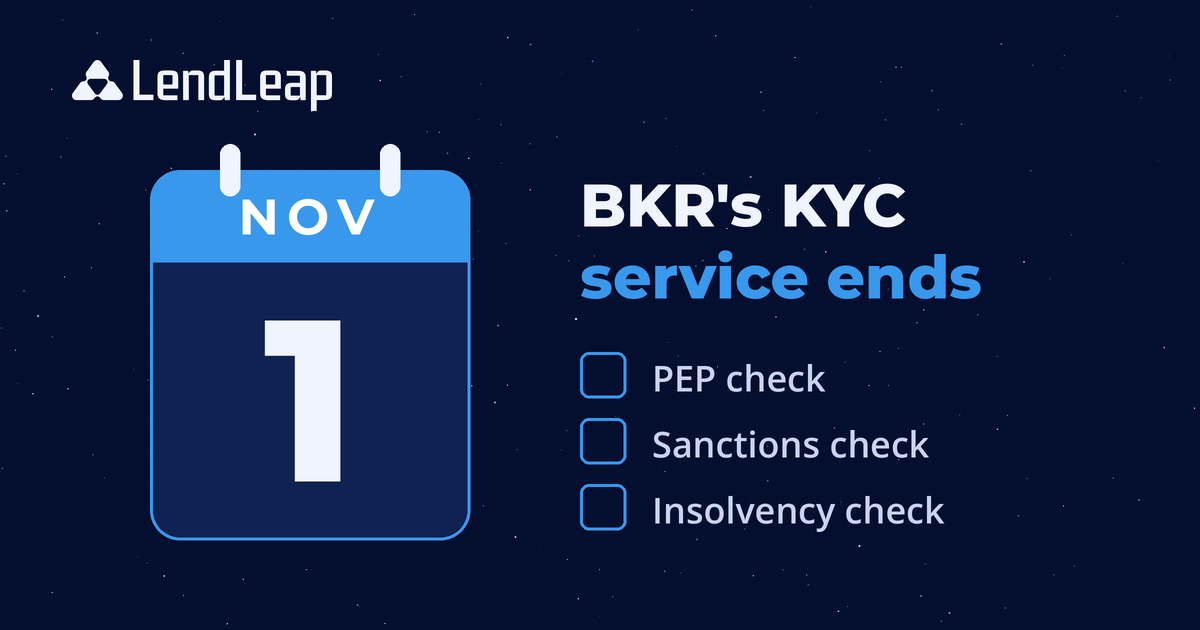
From 1 November 2026, BKR, the Dutch credit registration bureau, will no longer offer its KYC service. That means the end of its checks on politically exposed persons (PEPs), sanctions lists and insolvency. Many lenders have already arranged an alternative. Even so, this is a good moment to look beyond simply replacing it.
There is more going on. The rules on customer due diligence (KYC, Know Your Customer) and anti-money laundering (AML) will become stricter over the coming years and are being harmonised across Europe. Business lenders are increasingly affected too.
In this article you will read more about those checks on customers and money laundering risks. We leave consumer credit registration aside here. For specialist lenders in buy-to-let, bridging and commercial property, this is the part that matters, because the obligations also apply to corporate borrowers and the ultimate beneficial owners (UBOs) behind them.
BKR is dropping its KYC checks just as Europe tightens the rules
BKR's KYC service is going. BKR will stop providing PEP, sanctions and insolvency checks. It is worth knowing that BKR will continue to provide credit registration (the Central Credit Information System, CKI) and checks on stolen or missing identity documents (the Verification Information System, VIS). Only the KYC checks are affected. BKR says the reason is that large, specialist providers are now active in this field, and that part of the market already has its own solution. In other words, there are plenty of alternatives.
Europe is harmonising its anti-money laundering rules. Quite apart from BKR, the landscape is changing structurally. The new EU Anti-Money Laundering Regulation (AMLR) will apply directly in all member states from 10 July 2027. Much of what is currently set out in the Dutch Anti-Money Laundering and Anti-Terrorist Financing Act (Wwft) will then come from that regulation. The Wwft will remain in place for now, but the core of your customer due diligence will be European. The scope is widening as well, with crowdfunding platforms explicitly covered. And there is a new EU anti-money laundering supervisor, the AMLA.
For lenders, this means stricter and more uniform requirements for customer due diligence, UBO verification and ongoing monitoring of customers. You will also need to be able to demonstrate that you meet them.
Non-bank lenders are coming into view. Non-bank business lending in the Netherlands is currently subject to very little formal supervision. The Dutch Authority for the Financial Markets (AFM) supervises consumer credit, and business lending falls outside the regular supervisory framework. Even so, attention is growing. In 2025, De Nederlandsche Bank (DNB), the Dutch central bank, mapped for the first time how much SME finance comes from lenders outside the banking sector. It is repeating the exercise in 2026, now including fintech lending platforms. Lenders who can already show that their customer due diligence and AML controls are in order will be in a stronger position when new rules arrive.
Stricter rules call for checks built into your underwriting process
The checks need to run within your process. A KYC source needs to be integrated, so that the results land in the case file automatically. A separate system your team has to log into costs time and increases the risk of errors.
Stricter requirements call for a clear audit trail. Which check was run, when, and with what outcome? You need to be able to show that. Ideally it is recorded automatically in the case file, so you can reproduce it later.
With the LendLeap Platform, running KYC checks is effortless. LendLeap currently works with BKR for credit registration and these checks. In October we are bringing the PEP, sanctions and insolvency checks into our own KYC module, fully integrated into the LendLeap Platform. You run the checks from the case file with a single click, and the results are recorded in the file straight away. Your team does not need to log into a separate system, and your process stays exactly as it is.
Coverage, integration and record-keeping determine whether your KYC set-up works
Whether you are choosing a new source or reviewing your current set-up, three things matter most.
Coverage. Does the source cover all the checks you need? Think of screening individuals (PEPs, sanctions and adverse media), registers (insolvency, guardianship and financial administration) and identity (identity verification and the UBOs behind corporate customers). Also ask how often the data is refreshed. Sanctions lists change constantly.
Integration. Does the source run automatically as part of your underwriting process? Every additional tool your team has to use separately is a point where something can go wrong. Ideally, choose a set-up that lets you switch sources later without rebuilding your process. This will not be the last change.
Record-keeping. Can you see, for each case, which check produced which outcome and when? Under the new European rules, this is becoming increasingly important.
Ultimately, what matters most is how well the source fits your process. A solution that adapts to the way you work, and that you can adjust as rules or sources change, keeps you flexible. That is where a supplier who thinks along with you makes the difference.
Three steps to prepare your KYC process for the new rules
- Map where KYC checks sit in your process and which steps depend on them
- Check that your alternative to the BKR checks is properly integrated and records the outcomes
- Make sure the checks, and the records of them, run automatically within your underwriting process, with the European rules from 2027 in mind
Conclusion
The end of BKR's KYC service is above all a trigger. The bigger shift lies in the rules themselves. Customer due diligence and AML are becoming stricter, more European and easier to audit, and non-bank lenders are coming into view. Lenders who embed their checks firmly in the underwriting process now, with automatic record-keeping for every case, will be in a stronger position.
Preparing your KYC process for the new European rules? In October we are bringing the PEP, sanctions and insolvency checks into our own KYC module within the LendLeap Platform. Curious how that would work in your process? We would be happy to show you.
Sources
- The EU AML package and the new supervisor: AMLA, Authority for Anti-Money Laundering and Countering the Financing of Terrorism and the EUR-Lex summary of the AML package
- Growing attention for non-bank lenders: SME financing survey, De Nederlandsche Bank (in Dutch)